By Wish | Diplomatic Analysis
The Deep Freeze
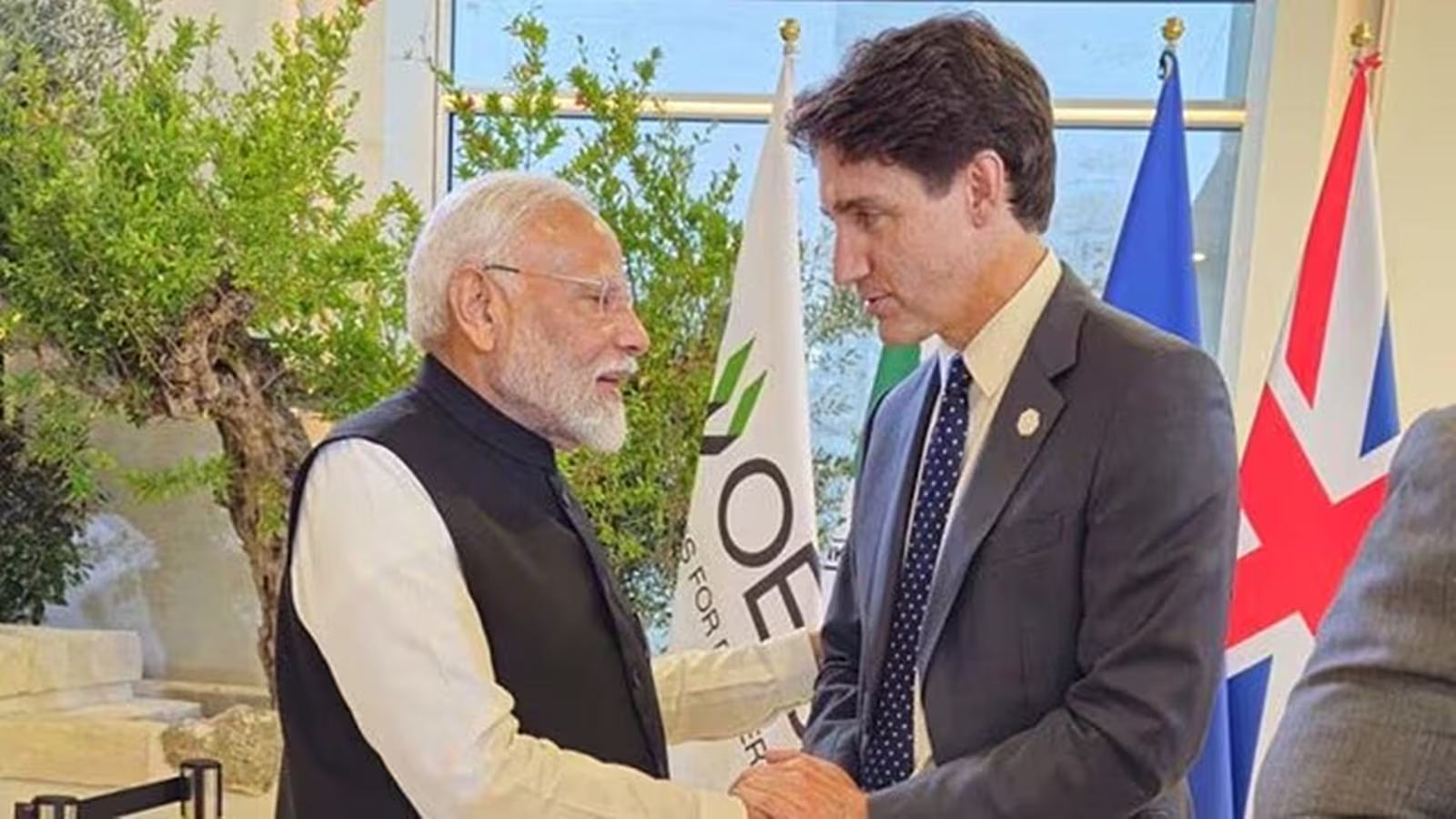
The diplomatic relationship between India and Canada has hit a historic low. What started as accusations regarding the killing of Hardeep Singh Nijjar has spiraled into a full-blown diplomatic crisis, involving expelled diplomats and suspended visa services.
However, viewing this merely as a “diplomatic spat” is a mistake. The cracks in India Canada Relations run much deeper than a single incident. It is a clash between India’s national security concerns and Canada’s domestic vote-bank politics.
This analysis decodes why this rift might be the new normal and how it impacts the broader Indo-Pacific strategy.
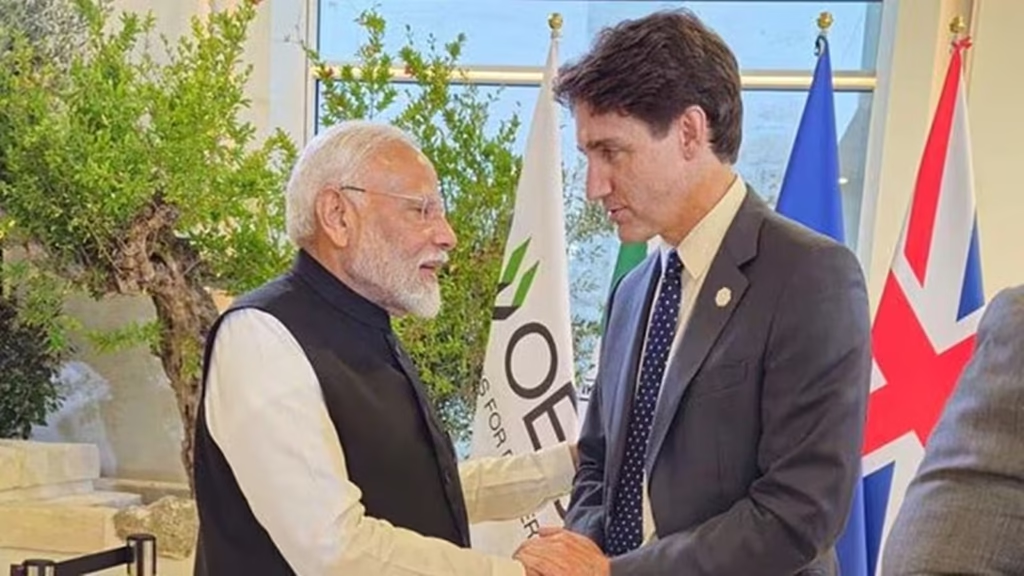
As of late 2025, the ‘Deep Freeze’ has begun to thaw. The leadership transition in Ottawa, with Prime Minister Mark Carney taking the helm, has shifted the focus from ideological confrontation to economic pragmatism. In a landmark meeting in late 2025, India’s External Affairs Minister S. Jaishankar and Canadian Foreign Minister Anita Anand outlined a roadmap to restore ties, prioritizing trade and security cooperation over past grievances.
The Executive Brief
(Why this matters in 30 seconds)
The Trigger: Justin Trudeau’s allegation of a “potential link” between Indian agents and the Nijjar killing.
The Core Issue: Canada’s leniency towards Khalistani separatism vs. India’s sovereignty.
The Fallout: Trade talks (CEPA) paused, diplomats expelled, and visa delays.
The Big Picture: Testing the West’s loyalty between a strategic partner (India) and an ally (Canada).
1. The “Five Eyes” Dilemma
Canada is a member of the Five Eyes Alliance (an intelligence-sharing pact between the US, UK, Canada, Australia, and NZ). India, on the other hand, is the cornerstone of the West’s strategy to counter China.
The crisis has put partners like the United States in a tough spot.
The US Position: Washington needs Ottawa (a traditional ally), but it desperately needs New Delhi (a strategic necessity against China).
The Balancing Act: So far, the US and UK have urged cooperation but have avoided condemning India publicly. This signals that for the West, the strategic value of India outweighs the diplomatic grievances of Canada.
2. The Khalistan Factor: Vote Bank Politics
To understand India Canada Relations, one must look at Canadian demographics. Sikhs make up nearly 2% of Canada’s population, but they are a highly organized political force.
The Jagmeet Singh Factor: Prime Minister Trudeau’s minority government relied on the support of the NDP, led by Jagmeet Singh, a known sympathizer of the separatist cause.
India’s Stance: India has repeatedly handed over “dossiers” of wanted terrorists living in Canada, but Ottawa has cited “Freedom of Speech” to refuse action. For India, this is not free speech; it is the glorification of violence (like the float celebrating Indira Gandhi’s assassination).
3. The Economic Cost: Trade Talks Frozen
The Economic Reset 2026
The narrative of ‘Frozen Trade’ is officially over. Following the high-level meeting between Prime Minister Narendra Modi and Canadian PM Mark Carney at the G20 Summit in November 2025, both nations have agreed to restart formal CEPA (Comprehensive Economic Partnership Agreement) negotiations.
The timeline is now set:
After the mandatory 90-day consultation period in the Canadian Parliament, formal talks are expected to commence by late February 2026. The goal is ambitious—doubling bilateral trade to $50 billion by 2030. Unlike previous attempts (EPTA), the focus has now shifted to ‘Critical Minerals’ (Lithium, Cobalt, Nickel) and Clean Energy. This strategic alignment aims to secure India’s EV manufacturing supply chain while positioning Canada as a reliable alternative to China.
Student & Immigration Update 2026:
The 2026 Immigration Pivot: Starting January 1, 2026, Canada is implementing a strict national study permit cap of 155,000 new arrivals—a nearly 50% reduction from previous years. However, in a major win for India’s high-skilled talent, Master’s and PhD students at public institutions are now fully exempt from this cap. According to latest IRCC updates, graduate students will no longer require a Provincial Attestation Letter (PAL), and Doctoral (PhD) applicants will benefit from an expedited 14-day study permit processing guarantee.
This ensures that while the influx of undergraduate and diploma students slows down, India’s top academic researchers continue to have a fast-track route to Canada. This diplomatic adjustment shows that despite the rift, India’s Soft Power remains a vital bridge between the two nations.
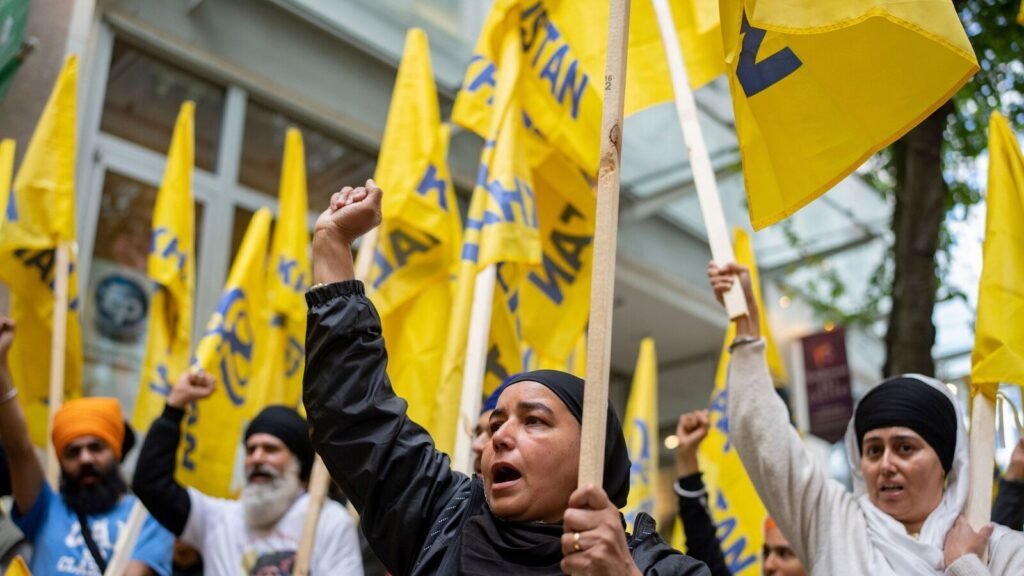
Frequent protests outside Indian missions have become a flashpoint in bilateral ties.
4. Is the Indo-Pacific Strategy at Risk?
Ironically, Canada released its own Indo-Pacific Strategy recently, identifying India as a “critical partner.”
The Contradiction: You cannot label a country a “critical partner” and then accuse its government of assassination in parliament without public proof.
China’s Gain: If there is one winner in this diplomatic mess, it is Beijing. The Chinese state media has eagerly highlighted this rift to push the narrative that “Western alliances are fragile” and that the Anglosphere will never truly treat India as an equal.
Conclusion: A Structural Break?
The India Canada Relations crisis is not going to be solved by a simple handshake. The trust deficit is too high. As long as Canadian soil is used to organize referendums for breaking up India, New Delhi will maintain a hard line.
We are witnessing a structural break. India has signaled that it is willing to sacrifice trade and diplomatic niceties to protect its “Core Interests.” The message to the West is clear: You cannot be a strategic partner in the Indo-Pacific while hosting our separatists in your backyard.
Read Next: [How India’s Soft Power (Diaspora) influences global politics beyond Canada.]