By Wish | [Geopolitical Intelligence]
The Geopolitical Chessboard: Beyond the Primakov Doctrine
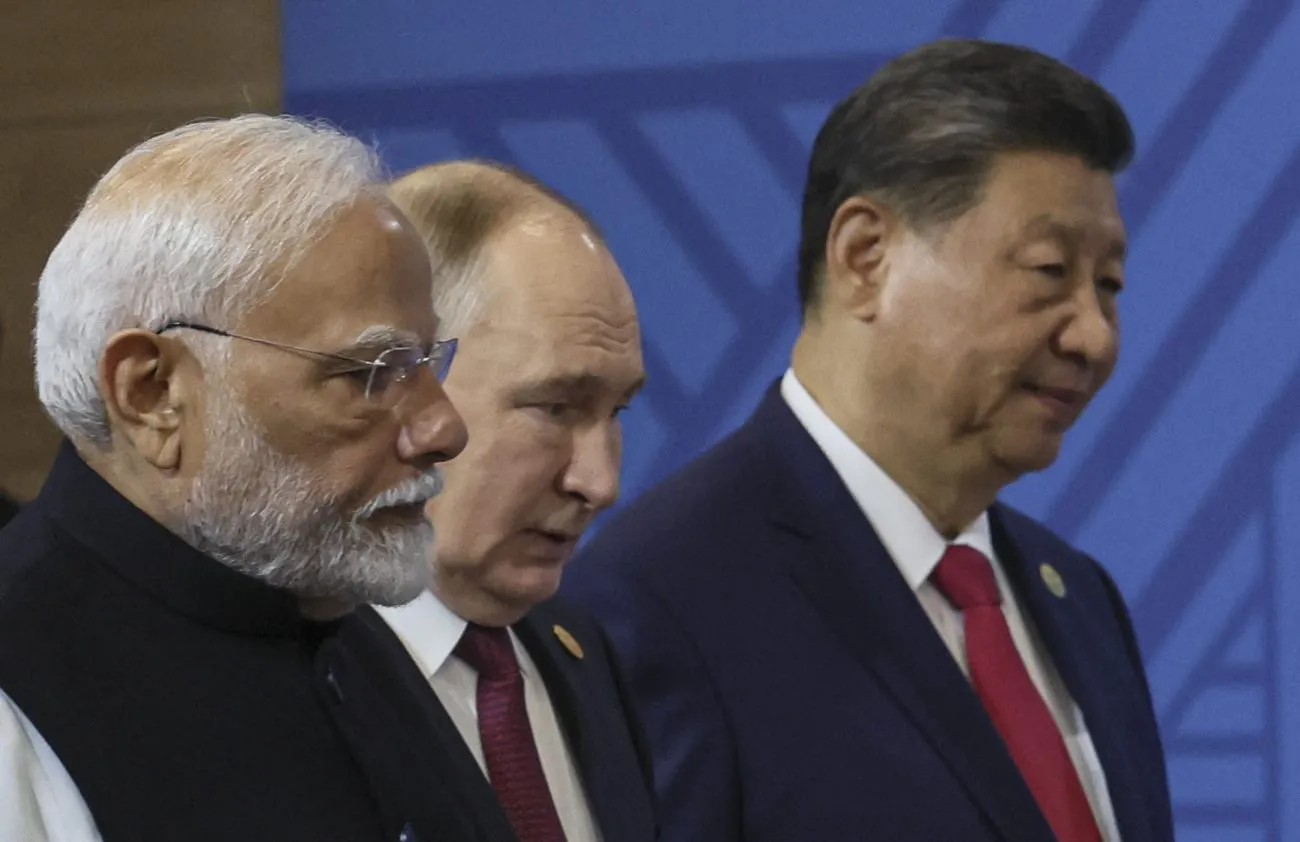
History does not move in straight lines; it moves in triangles. For the last two decades, the most dangerous yet defining geometry in global politics has been the India Russia China Triangle.
In the late 1990s, Russian statesman Yevgeny Primakov envisioned a “Strategic Triangle” between Russia, India, and China (RIC) to counter Western hegemony. However, by 2025, that vision has morphed into a complex game of survival. Following the conclusion of the high-stakes summit between Prime Minister Narendra Modi and President Vladimir Putin in December 2025, this triangle has undergone a seismic shift.
The Western media often simplifies this relationship, claiming that Russia has become a “vassal state” of China. They argue that Moscow, crippled by sanctions and the Ukraine war, has no choice but to abandon New Delhi to please Beijing. They predict that when the chips are down, Putin will choose Xi Jinping over Modi.
But the events of the last few weeks—the secret S-500 talks, the Arctic access via RELOS, and the calculated silence on the Ladakh border tell a completely different story. India has not only managed to keep Russia neutral but has actively used Moscow as a wedge to prevent a complete Chinese hegemony in Eurasia.
This mega-analysis compiles every major development of late 2025 to decode how New Delhi is mastering the India Russia China Triangle.
Strategic Data: The Balance of Power (2025)
Before we analyze the moves, we must look at the raw capabilities and stances of the three players in this India Russia China Triangle.
| Parameter | India (The Balancer) | Russia (The Hinge) | China (The Challenger) |
| Primary Goal | Strategic Autonomy | Survival against West | Global Dominance |
| Stance on Himalayas | Sovereignty is non-negotiable | Neutral (“Bilateral Issue”) | Aggressive Expansion |
| Key Leverage | Pharmaceutical & Labor | Energy & Weapons Tech | Manufacturing Power |
| Weakness | Energy Dependence | Reliance on China | Malacca Strait Dilemma |
| Nuclear Warheads | 170+ (Estimated) | 5,580 (Declared) | 500+ (Rapidly Expanding) |
1. The Diplomatic Coup: Debunking the ‘Vassal State’ Theory
The biggest fear in the corridors of South Block was that Russia would succumb to Chinese pressure. Since the Ukraine war began, Russia’s trade with China has exploded to over $240 billion annually. Logic dictated that a cash-strapped Putin would eventually side with Xi Jinping on critical issues like the India-China border dispute.
However, the December summit proved otherwise. President Putin’s explicit statement that the border tensions are “bilateral issues” in which third parties should not interfere was a diplomatic masterstroke for India.
Why does this matter?
In the India Russia China Triangle, neutrality is a weapon. If Russia were to fully ally with China militarily, it could theoretically choke the supply of spare parts for India’s Su-30MKIs and T-90 tanks during a war. By securing Russia’s explicit neutrality, India has ensured that its supply lines remain open, regardless of Beijing’s objections.
New Delhi understands a psychological truth that the West ignores: Moscow secretly fears becoming Beijing’s junior partner. Russia prides itself on being a superpower. Being subservient to China hurts the Russian national psyche. By empowering India, Russia creates a balance in Asia, ensuring it doesn’t have to bow entirely to China. India is Russia’s “insurance policy” against total Chinese dominance.
2. The Hardware Equation: S-500 and the Hypersonic Shield
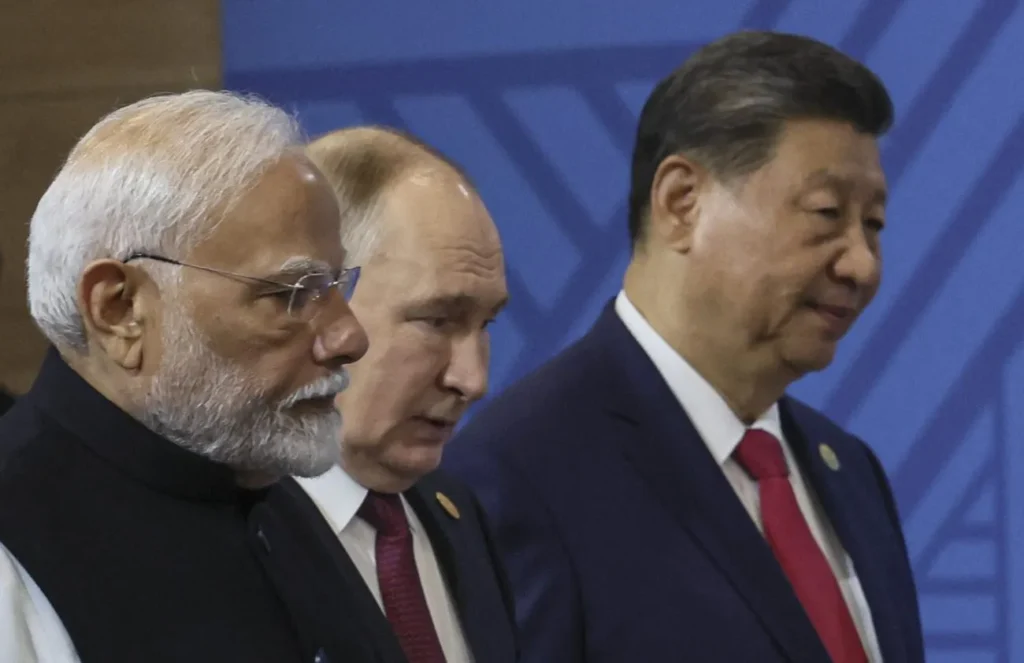
Diplomacy is good, but deterrence requires firepower. The most tangible outcome of the recent interactions in the India Russia China Triangle has been the upgrade in military hardware.
As we detailed in our previous report on the [India Hypersonic Missile], China has deployed the DF-17 hypersonic glide vehicle, a weapon designed to bypass traditional radars. The US has been hesitant to share top-tier missile defense tech like THAAD or Aegis with India without strings attached. Russia, however, has stepped in.
The preliminary talks for the S-500 Prometheus system are a direct response to China’s rocket force. The S-500 is not just an anti-aircraft system; it is an anti-space weapon.
Range: 600 km.
Target: Hypersonic missiles and Low Earth Orbit (LEO) satellites.
This deal changes the calculus. If India acquires the S-500, it negates China’s advantage in missile technology. Furthermore, the renewed interest in the Su-57 Felon stealth fighter indicates that India is looking for an immediate solution to counter China’s J-20. While the West offers F-21s (upgraded F-16s), Russia is offering 5th-generation stealth. By keeping the defense pipeline active, India ensures that its military remains formidable enough to make China think twice.
3. Reshaping the India Russia China Triangle: The Maritime Pincer
This is where the strategy becomes truly multi-dimensional. India has effectively engaged Russia to counter China’s maritime expansion, creating a pincer movement from the North Pole to the Indian Ocean.
The North: RELOS Agreement
China calls itself a “Near-Arctic State” and is building a “Polar Silk Road.” It wants to dominate the Northern Sea Route to bypass the US-controlled oceans. As analyzed in our report on the [RELOS Agreement India], India’s pact with Russia grants the Indian Navy access to Arctic ports like Murmansk. This dilutes China’s influence in the region. Russia prefers India’s benign presence in its backyard over China’s aggressive expansionism.
The South: Agalega Island
While engaging Russia in the North, India has fortified the South. The operationalization of the [Agalega Island India Base] allows India to dominate the Indian Ocean.
China’s “Malacca Dilemma”—its fear that its energy supplies can be cut off in the Indian Ocean—has just become a reality. China is now being watched by Indian assets in the freezing Arctic (via Russian cooperation) and the tropical Indian Ocean (via Agalega). The India Russia China Triangle is not just played on land; it is being played across the seven seas.
4. The Economic Lifeline: Energy as a Shield
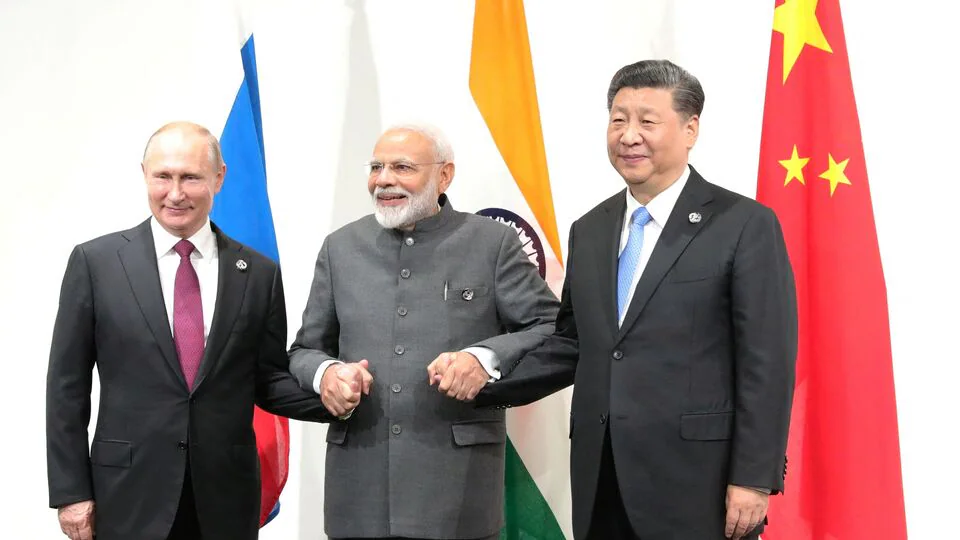
Economy is the fuel of war. China’s economy is five times larger than India’s, giving it immense sustaining power. To counter this, India has leveraged the “Russia Card” to secure cheap energy.
By importing discounted Russian oil, India has saved billions of dollars—money that has been redirected into infrastructure and defense spending. But there is a deeper strategic game here involving the India Russia China Triangle.
The De-Dollarization Angle
Both Russia and China want to de-dollarize the global economy. India supports this selectively. India pays for Russian oil in non-dollar currencies (Rupees, Dirhams), but it refuses to use the Chinese Yuan.
This distinction is critical. If India started paying Russia in Yuan, it would strengthen China’s currency globally. By refusing to do so, India acts as a spoiler to China’s financial ambitions while still keeping the Russian economy afloat. A solvent Russia is in India’s interest; a collapsed Russia becomes a Chinese colony.
5. The Nuclear Dimension: The Silent Arms Race
A largely unspoken aspect of the India Russia China Triangle is the nuclear buildup.
China is rapidly expanding its nuclear arsenal, aiming for 1,000 warheads by 2030. It is building hundreds of new missile silos in its western desert, clearly targeting India and the US.
India’s response has been the consolidation of its Nuclear Triad (Land, Air, Sea). The cooperation with Russia on the Akula-class nuclear attack submarine (leased to India) and the design support for India’s own SSBNs (Arihant class) is vital. Russia is the only country willing to share nuclear propulsion technology with India. The US and France hesitate in this domain. This nuclear cooperation ensures that India maintains a credible “Second Strike Capability” against China, keeping the peace through Mutually Assured Destruction (MAD).
6. Why China is Worried about the Triangle
If you read the editorials in China’s state-run Global Times, the anxiety is palpable. Beijing’s grand strategy was to isolate India: keep Pakistan active on the West, pressure the Himalayas in the North, and encircle the Indian Ocean with the String of Pearls.
However, India’s “Multi-Alignment” has broken this encirclement.
India talks to the US for technology (Jet Engines, Drones).
India talks to Russia for strategic weapons (S-400/500, Nuclear Subs).
India talks to France for naval power.
China realizes that it cannot bully India as long as New Delhi has the backing of Moscow. Beijing wants a bipolar world (China vs. USA), but India, supported by Russia, insists on a multipolar world. The dynamics of the India Russia China Triangle prevent the rise of a unipolar Asia dominated by Beijing.
Conclusion: The Art of the Impossible
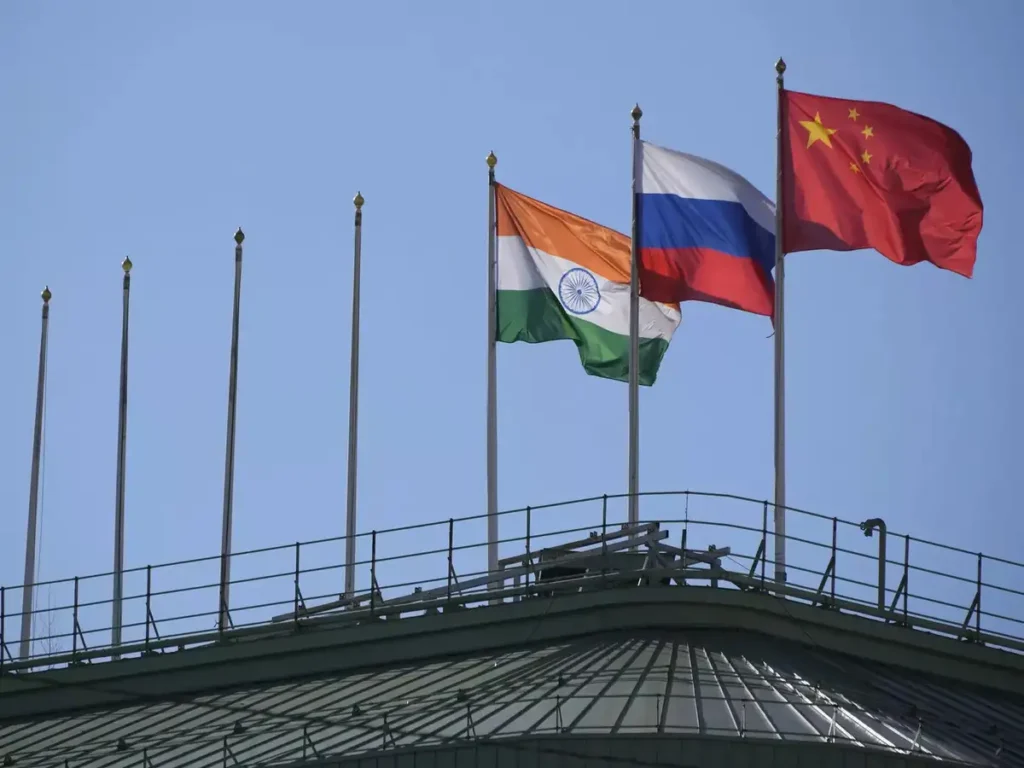
The year 2025 has proven that the India Russia China Triangle is not an isosceles triangle where two sides are equal. It is a dynamic shape where the angles keep changing.
India’s strategy is a masterclass in realism. New Delhi knows it cannot fight China and the West simultaneously. It also knows it cannot trust the West blindly. Therefore, Russia remains the “Keystone” of Indian foreign policy.
By concluding the S-500 talks, signing RELOS, and securing energy deals, India has used Russia to counterbalance China’s weight. As long as the telephone line between New Delhi and the Kremlin remains open, Beijing cannot claim total dominance over Asia. The Dragon may breathe fire, but the Bear and the Elephant have decided to hold their ground together.
What do you think?
Will Russia continue to support India if a full-scale war breaks out with China in 2026? Let us know in the comments below.
Read Next: [Agalega Island India Base: 5 Reasons It Is A Strategic Masterstroke]