
By Wish
Quick Summary:
The Concept: What is a Nuclear Triad and why does India need it?
Land: The Agni Series – Striking Beijing from Odisha.
Air: The Rafale Factor – Speed and Stealth.
Sea: INS Arihant – The Invisible Second Strike Capability.
India’s Nuclear Triad is the bedrock of national security in a volatile neighborhood. Surrounded by two nuclear-armed adversaries (China and Pakistan), New Delhi cannot rely solely on conventional weapons.
For years, India followed a doctrine of “Credible Minimum Deterrence.” But the geopolitical landscape has shifted. With China expanding its nuclear arsenal and Pakistan flaunting tactical nukes, India has quietly operationalized a fully functional Nuclear Triad—the ability to launch nuclear warheads from Land, Air, and Sea.
This analysis decodes the three pillars that keep India safe, ensuring that if an enemy ever dares to strike first, the retaliation will be catastrophic and unavoidable.
Pillar 1: Land – The Agni Series (The Backbone)
The land-based leg is the oldest and most mature part of India’s Nuclear Triad. It is managed by the Strategic Forces Command (SFC). While the Prithvi missiles target Pakistan, the Agni Series is designed with China in mind.
The Game Changer: Agni-V The induction of the Agni-V Intercontinental Ballistic Missile (ICBM) changed the equation.
Range: With a range of over 5,000 km, it can strike targets as far as Beijing and Shanghai from deep within India.
Canister Launch: Unlike older missiles, Agni-V is canister-based. This means it can be launched from a moving truck anywhere in India, making it nearly impossible for enemy satellites to track and destroy before launch.
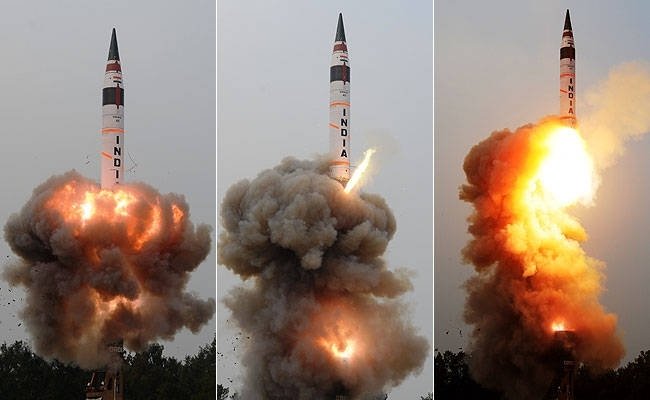
The Future: Agni-P (Prime) India is now testing the Agni-P, a new-generation missile with composite materials. It is lighter, faster, and harder to intercept by anti-ballistic missile systems.
Pillar 2: Air – Rafale and The Delivery Mechanism
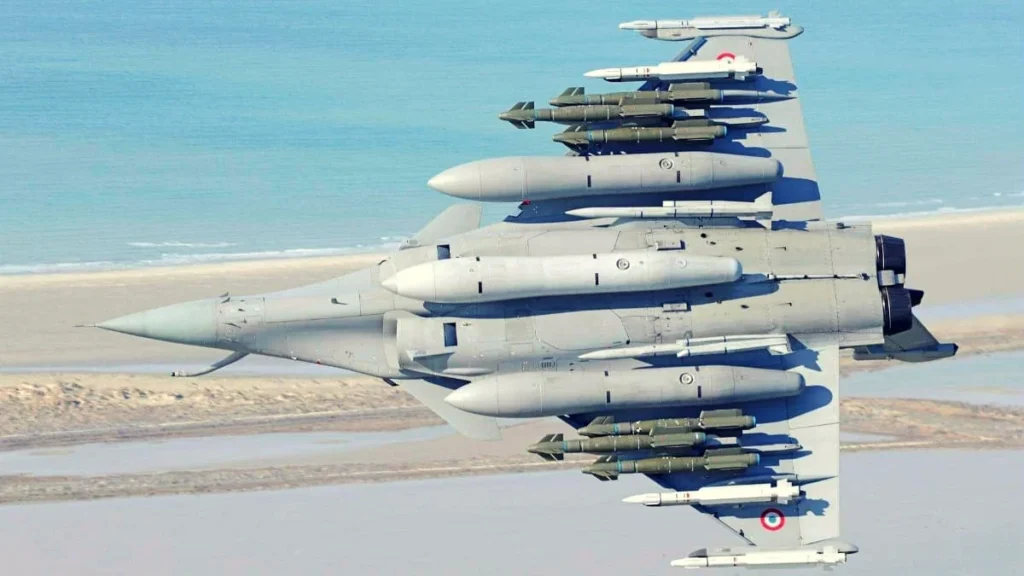
Air power offers flexibility. A missile once launched cannot be recalled, but a fighter jet can. For decades, the Mirage 2000 (which delivered the laser-guided bombs in Kargil) was the primary air vector for nuclear weapons. However, the induction of the French-made Rafale has upgraded this leg significantly.
The Meteor Edge: The Rafale can carry nuclear gravity bombs and launch them from a standoff distance, staying out of reach of enemy air defense systems.
Survivability: With its advanced electronic warfare suite (SPECTRA), the Rafale can jam enemy radars, penetrate deep into hostile airspace, deliver the payload, and return.
While land missiles are for massive retaliation, air vectors signal “Political Will” and readiness during a crisis escalation.
Pillar 3: Sea – The Invisible Survivor (SSBNs)
This is the most critical leg of India’s Nuclear Triad. India follows a “No First Use” (NFU) policy. This means India will never strike first. But this also means India must survive a first strike by the enemy. Land bases can be bombed. Airbases can be destroyed. But a nuclear submarine hidden deep in the ocean is virtually impossible to detect.
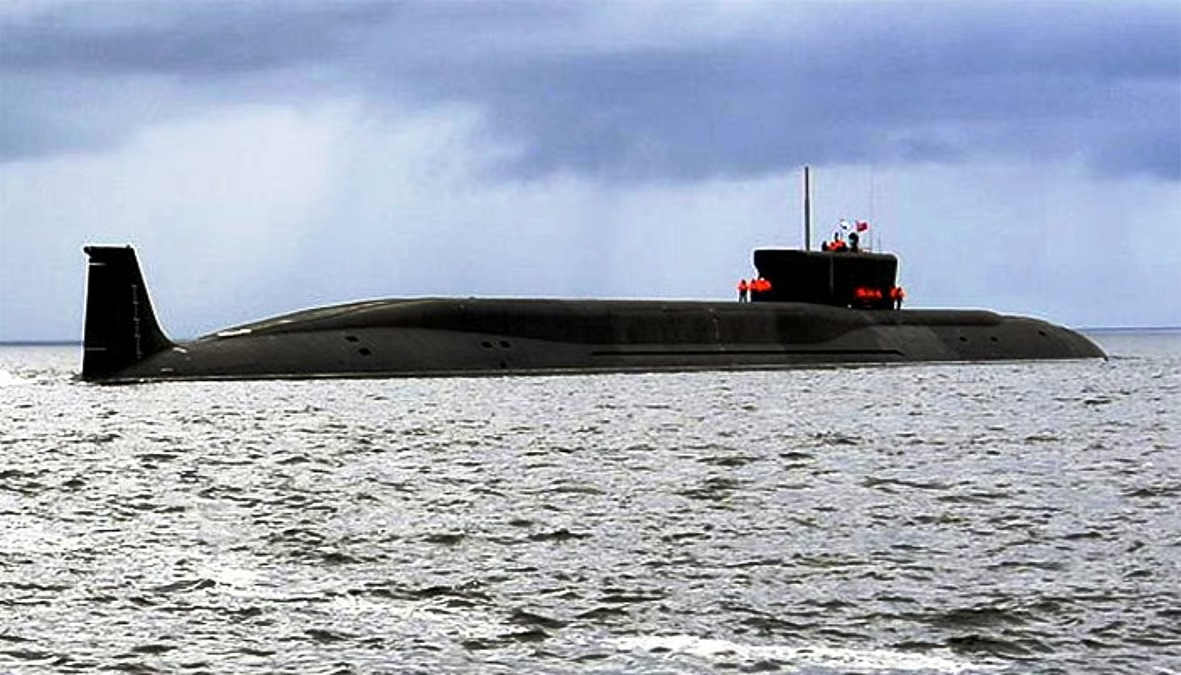
INS Arihant & INS Arighat The INS Arihant is India’s first indigenous nuclear-powered ballistic missile submarine (SSBN). It completes the triad.
Second Strike Capability: If India is attacked, INS Arihant, lurking silently in the Bay of Bengal or the Indian Ocean, will rise to periscope depth and launch K-15 or K-4 missiles to destroy the enemy.
The K-4 Missile: With a range of 3,500 km, the K-4 missile launched from these submarines can reach critical targets in China while staying safely in Indian waters.
The recent commissioning of INS Arighat (the second submarine) ensures that at least one SSBN is always on patrol, providing 24/7 deterrence.
The Command Structure: Who Presses the Button?
Having weapons is one thing; controlling them is another. India’s nuclear button is not a physical button but a complex chain of command.
Political Council: Headed by the Prime Minister. Only he can authorize a nuclear strike.
Executive Council: Headed by the National Security Advisor (NSA), which executes the order.
Strategic Forces Command (SFC): The military wing that actually fires the weapon.
This robust structure prevents accidental launches or rogue actions, giving India the reputation of a “Responsible Nuclear Power.”
Conclusion: Peace Through Strength
The completion of India’s Nuclear Triad is not about war-mongering; it is about guaranteeing peace. In the harsh reality of geopolitics, weakness invites aggression. By securing the ability to strike from land, air, and sea, New Delhi has drawn a clear red line. As the “String of Pearls” tightens in the ocean and borders heat up in the Himalayas, the Triad stands as the silent guardian of India’s sovereignty.
Related Analysis: [Read how the BrahMos Missile export complements India’s nuclear deterrence.]