Global Space Warfare 2026: The Rise of Astropolitics and India’s 4D Military Space Doctrine
Strategic Intelligence Report | By Wish, Geopolitical Analyst
The Intelligence Brief: Space as the Final Combat Domain
As of January 2026, the strategic center of gravity has officially shifted from the terrestrial Line of Actual Control (LAC) and the maritime chokepoints of the Indo-Pacific to the silent vacuum of the exosphere. We have entered the era of ‘Astropolitics’, where the control of orbital lanes is as vital as the control of the high seas was in the 19th century. Space is no longer a purely scientific or civilian frontier; it is the Fifth Domain of Warfare.
With the global orbital economy projected to reach $1.1 Trillion by 2030, the protection of satellite constellations is no longer just a technical requirement—it is a cornerstone of national sovereignty. The year 2025 saw a massive escalation in counter-space capabilities, including “stalker satellites” and ground-based laser dazzlers. In response, New Delhi has transitioned from a civilian-led space posture to a unified Defence Space Command (DSC) under its first-ever Military Space Doctrine 2026.
This report decodes the shift from kinetic kill to the sophisticated “4D Shield” and the technologies that will define global security in 2026.
1. India’s Military Space Doctrine 2026: The Great Reset
For decades, India maintained a ‘peaceful use of space’ policy. However, the militarization of space by adversaries, manifesting in the integration of space assets into their Western Theatre Command has forced a doctrine reset. The Military Space Doctrine 2026 is India’s formal recognition that space is a contested and congested arena.
The Shift to Defensive Resilience
The doctrine’s primary focus is not space-based weapons, but Resilience. The Indian government realizes that if its communication and navigation satellites (NavIC) are blinded, its entire military infrastructure, including the Project Kusha Sky Shield, will be paralyzed.
Unified Space Command: The Defence Space Agency (DSA) has officially been upgraded to a Space Command in early 2026. It now integrates intelligence from all three services (Army, Navy, Air Force) into a single orbital operating picture.
Satellite Hardening: All satellites launched in the 2026 roadmap are “hardened” against Electromagnetic Pulses (EMP) and radiation, ensuring they can survive an electronic warfare environment.
2. DefSat 2026: Decoding the ‘IndSpaceX Wargame 4.0’
One of the most trending topics in global defense circles for 2026 is DefSat 2026, India’s flagship defense-space conference and expo. This year, the focus has moved beyond capability creation to institutionalized adoption.
The 4D Strategy: Deny, Disturb, Degrade, Destroy
At the heart of DefSat 2026 is the IndSpaceX Wargame 4.0. This exercise is designed to test India’s resilience against a coordinated space attack using the 4D Framework:
Deny: Using ground-based electronic jammers to prevent an adversary from receiving their own satellite data over Indian territory.
Disturb: Creating “noise” in the uplink and downlink frequencies to interrupt the adversary’s command-and-control loops.
Degrade: Utilizing cyber-warfare to reduce the resolution of enemy imagery or the accuracy of their GPS signals.
Destroy: The “Kinetic Option.” Building on the 2019 ASAT success, India maintains the ability to physically intercept a satellite, though this is now considered a last-resort “deterrent.”

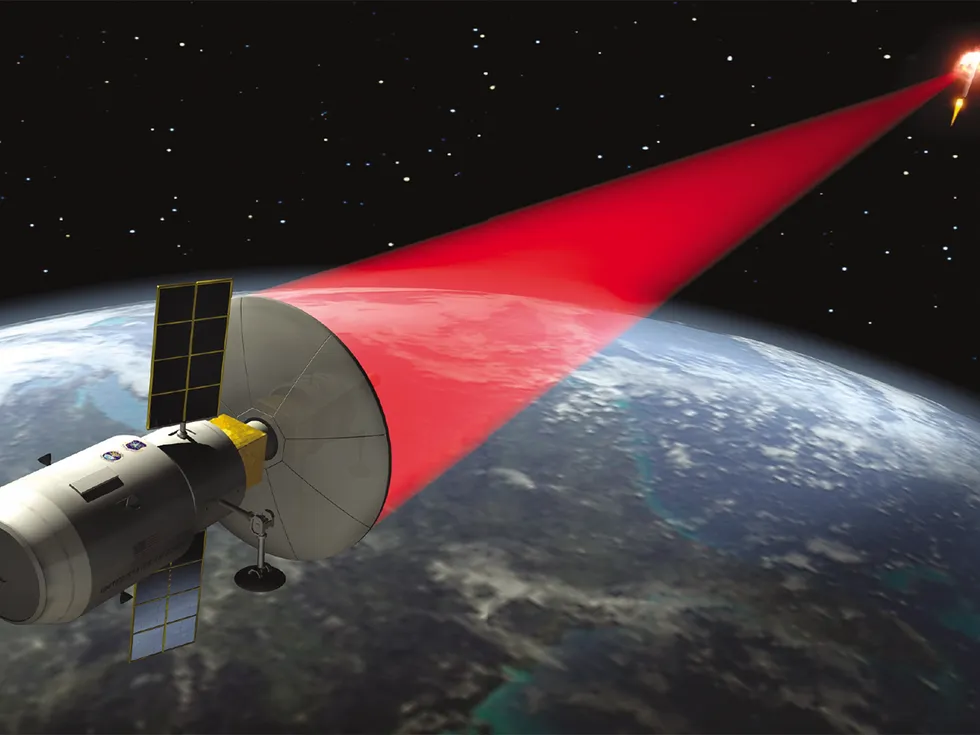
3. Directed Energy Weapons (DEWs): The Speed-of-Light Intercept
The kinetic destruction of a satellite creates “Space Junk” (debris), which can inadvertently destroy one’s own assets—a phenomenon known as the Kessler Syndrome. To avoid this, Global Space Warfare 2026 has pivoted toward Directed Energy Weapons (DEWs).
Project Sahastra Shakti: The Mk-IIA Breakthrough
By January 2026, India’s Project Sahastra Shakti has moved into operational testing. The latest variant, the Mk-IIA, is a vehicle-mounted laser system.
Technical Specs: The Mk-IIA utilizes six 5kW laser beams to produce a combined 30kW power output.
Operational Range: It can effectively “blind” optical sensors and burn through small UAVs at a range of 5 kilometers.
The Future (Project Surya): DRDO is currently fast-tracking Project Surya, a massive 300kW laser system designed for high-altitude denial, effectively creating a “laser wall” against orbital threats.
KALI: The Electronic Predator
The Kilo Ampere Linear Injector (KALI) remains India’s most classified and lethal space-defense asset. KALI is not a laser; it is a Relativistic Electron Beam (REB) accelerator.
Impact: Instead of physical impact, KALI emits a high-power microwave pulse that “fries” the electronic circuits and microchips of an incoming missile or a stalker satellite instantly.

4. The 52-Satellite Shield: Securing the Indian Frontier
A critical part of the 2026 roadmap is India’s plan to launch 52 strategic defense satellites by April 2026. This constellation will provide a 360-degree surveillance net over the Indian Ocean and the Himalayan borders.
Key Strategic Launches (March 2026 Roadmap)
ISRO has confirmed a packed schedule of seven strategic missions by March 2026:
EOS-N1 (Earth Observation Satellite): A dedicated platform for strategic users, designed for sub-meter resolution imagery.
GSLV F17/EOS-05: A high-orbit strategic satellite for wide-area surveillance.
- SSLV Missions: The Small Satellite Launch Vehicle (SSLV) is now the backbone of “Responsive Space.” India can now replace a damaged satellite within 48 to 72 hours—a capability previously held only by the US and China.
5. Global Space Situational Awareness (SSA): Tracking the Chaos
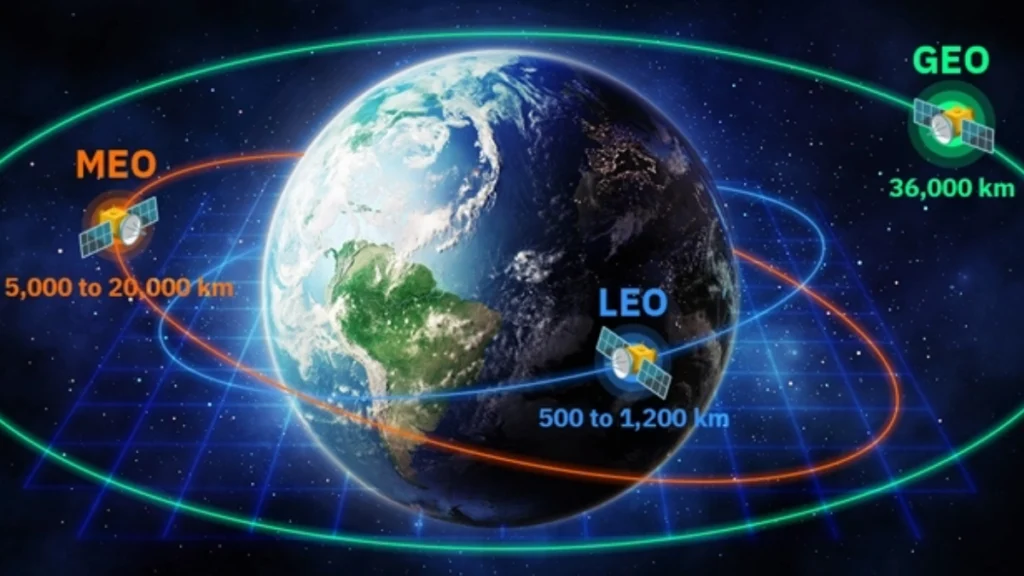
Space is becoming crowded. With over 10,000 active satellites and millions of pieces of debris, Space Situational Awareness (SSA) has become a $2.5 billion global market.
Project Netra: India’s Orbital Radar
Project Netra is India’s early warning system in space. By 2026, it has been integrated with ground-based LiDAR and telescopes in Ladakh and Mount Abu.
AI-Powered Satellite Grid: The DSC uses an AI-powered grid to predict potential conjunctions (collisions) and detect “active” maneuvers by adversary satellites.
Bodyguard Satellites: One of the most futuristic components of India’s strategy is the deployment of Bodyguard Satellites. These small, maneuverable units orbit near high-value assets to monitor and counter any “satellite-grabbing” robotic arms from hostile powers.
6. Technical Integration: The Silicon and Command Link
Space warfare is fundamentally a battle of algorithms.
Sovereign Silicon: All DSC assets now run on indigenous processors manufactured under the India Semiconductor Mission 2026. This ensures that India’s orbital code cannot be “switched off” via foreign backdoors.
Theatre Command Integration: The Space Command provides the primary data-link for the Maritime Theatre Command and the Himalayan Frontier Highway sensors, creating a “Unified Kill-Chain.”
The Space Resilience Formula
In 2026, military analysts use the Orbital Sustainability Index (OSI) to calculate the survivability of a satellite constellation:
Where:
C = Connectivity Redundancy (%)
R = Resilience to Jamming (dB)
S = Speed of Replacement (hours)
D = Density of Hostile Assets in Orbit
7. Economic Sovereignty: The Space Activities Bill 2026
To sustain this defense architecture, India has moved to legalize and incentivize commercial space through the Space Activities Bill.
Space PLI Scheme: The government has introduced a Production Linked Incentive (PLI) for space manufacturing, encouraging private players like Skyroot and Pixxel to build defense-grade hardware.
$1 Trillion Economy: India aims to capture 10% of the global space economy by 2030, using its low-cost launch capability and “Trusted Partner” status under the iCET pact with the US.
8. Global Comparison: The 2026 Orbital Balance of Power
| Power | Strategy/Doctrine | Primary Counter-Space Asset | Key Strength |
| USA | Starshield/Global Hegemony | X-37B Space Plane/Cyber Denial | Technical Supremacy |
| China | Bio-Silk Road/A2-AD Space | Robotic Grasper Arms (Shijian) | Satellite Volume |
| India | 4D Shield/Defensive Resilience | KALI (REB) / Surya (Laser) | Sovereign Code/Low-Cost |
| Russia | Asymmetric Orbital Denial | Co-orbital Jammers/Nukes | Legacy Experience |
Conclusion: The Future of Sovereignty is Orbital
Global Space Warfare 2026 is not a science fiction scenario; it is a current reality. The nation that controls the high ground of space controls the destiny of its people. By implementing the 4D Strategy, institutionalizing the Space Command, and mastering Directed Energy Weapons, India has ensured that its rise as a global power is protected by an invisible, light-speed shield.
The mountains and oceans are no longer the only borders we defend; the tricolor now flies as a guardian in the silent, star-lit frontier of the cosmos.
Recommended Reading: The 2026 Strategic Matrix
Silicon Sovereignty: India Semiconductor Mission 2026: The Micron & Tata Reality
Himalayan Fortress: Frontier Highway India 2026: Building the Strategic Spine
Missile Shield: Project Kusha India Sky Shield 2026: The Indigenous Iron Dome
Bio-Defense: Project Sanjeevani: India’s Bio-Shield 2026 Intelligence