
By Wish
Quick Summary:
The Crisis: Red Sea attacks prove the Suez Canal is a “choke point.”
The Solution: A new 5,600 nautical mile route connecting Chennai to Russia.
The Economics: Saving 16 days and millions in freight costs.
The Geopolitics: Breaking China’s monopoly on the Northern Sea Route.
The Eastern Maritime Corridor is India’s boldest strategic move in logistics. While global trade is a game of logistics, and for over a century, the Suez Canal has been the only game in town for trade between Europe/Russia and Asia. But recent geopolitical shocks—from the blockage of the canal by the Ever Given ship to the Houthi drone attacks in the Red Sea—have exposed a terrifying reality: The world’s main trade artery is fragile.
While the West scrambles to secure the Red Sea, New Delhi and Moscow have quietly activated a strategic Plan B that has been in the works for years: the Eastern Maritime Corridor (EMC).
This is not just a shipping lane. It is arguably India’s most significant geoeconomic move to secure its energy future and counter China’s dominance in the Arctic.
Deconstructing the Route: The Math of Logistics
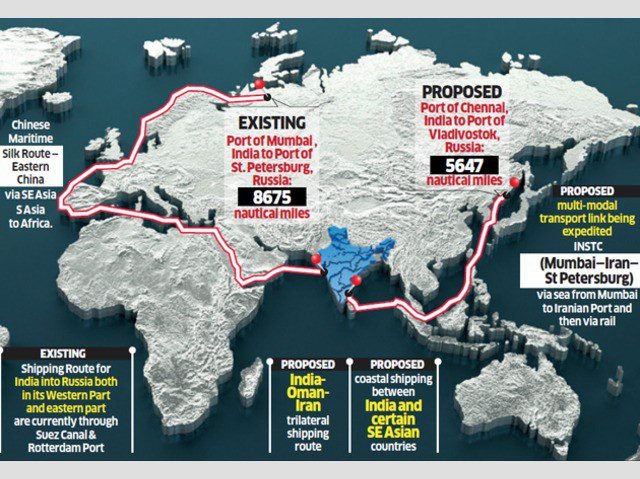
To understand why the Eastern Maritime Corridor is a game-changer, we must look at the numbers. Currently, a ship traveling from Mumbai to St. Petersburg (Russia) via the traditional Suez Canal route covers a massive distance of 8,675 nautical miles.
Time Taken: 35 to 40 days.
Risks: High insurance premiums due to piracy in Somalia and war risks in the Red Sea.
The EMC Alternative: The new corridor connects the port of Chennai on India’s East Coast directly to Vladivostok in Russia’s Far East, passing through the Strait of Malacca and the Sea of Japan.
Distance: Reduced to just 5,600 nautical miles.
Time Taken: Cargo reaches in 24 days.
The Saving: A reduction of nearly 16 days in transit time.
For a logistics company, saving 16 days of fuel and charter costs translates to millions of dollars per voyage.
The “Red Sea” Effect: Why Now?
The activation of the Eastern Maritime Corridor wasn’t just about economics; it was forced by security. Since late 2023, the Red Sea has turned into a war zone. Houthi rebels have targeted merchant vessels, forcing shipping giants like Maersk to divert ships around the entire continent of Africa (Cape of Good Hope). This adds weeks to the journey and spikes inflation.
India, which imports 85% of its oil, cannot afford these disruptions. The EMC provides a safe, conflict-free route for energy supplies. Unlike the volatile Middle East, the waters between Chennai and Vladivostok pass through ASEAN nations and the Pacific, regions where India has strong naval partnerships.
The Prize: Unlocking Russia’s Far East
This corridor is primarily fueled by India’s hunger for energy. Prime Minister Narendra Modi’s “Act Far East” policy was designed specifically to tap into this region. Russia’s Far East is a resource-rich but sparsely populated region, holding massive reserves of:
Crude Oil & LNG: Since the Ukraine conflict, Russia has become India’s top oil supplier. The Eastern Maritime Corridor ensures these supplies can reach Indian refineries (like Paradip and Vizag) without passing through European-monitored waters.
Coking Coal: India’s steel industry is heavily dependent on imported coking coal. Vladivostok is a hub for high-quality coal, which is essential for India’s infrastructure boom.
Diamonds & Gold: The Yakutia region, accessible via Vladivostok, is rich in precious minerals that India’s jewelry industry demands.
Geopolitics: Checkmating China’s “Polar Silk Road”
Perhaps the most silent but significant impact of the Eastern Maritime Corridor is on China. Beijing has declared itself a “Near-Arctic State” and is aggressively building its “Polar Silk Road” to control trade routes through the melting Arctic ice. China wants to be the gatekeeper of the Northern Sea Route.
By establishing the EMC, India ensures it has its own foothold in the Russian Far East.
Preventing Dependency: If India does not invest in Vladivostok, Russia would be forced to rely entirely on China for the development of its Far East. This would turn the region into a Chinese economic vassal.
Indian Presence: India has already committed a $1 billion line of credit for the development of the Russian Far East. Indian workforce and companies are moving in, balancing the overwhelming Chinese presence in the region.
The Challenges Ahead: The Ice Factor
However, the Eastern Maritime Corridor is not without its challenges. The primary obstacle is the weather.
Winter Navigation: Vladivostok and the route northwards can be ice-bound in winter. While modern ice-breakers make it navigable, it requires specialized “Ice-Class” vessels which are more expensive to build.
Infrastructure: While Chennai is a deep-water port, the connectivity on the Russian side needs massive upgrades to handle the volume of cargo India plans to send.
Integrating with Domestic Ports
The success of the EMC depends on India’s own port infrastructure. The corridor is not limited to Chennai. It is being integrated with:
Paradip Port (Odisha): For coal and iron ore.
Visakhapatnam (Andhra Pradesh): For naval security and oil refining.
Kolkata: For connecting the route to India’s Northeast and Nepal/Bhutan.
This integration (Sagarmala Project) ensures that goods arriving from Russia can be quickly transported to India’s industrial hinterland.
Conclusion: A Strategic Insurance Policy
The Eastern Maritime Corridor transforms the India-Russia partnership from a transactional “Buyer-Seller” relationship (guns and oil) to a “Strategic Logistics” partnership.
In a world where trade routes are becoming weaponized, relying solely on the Suez Canal is a national security risk. The EMC is India’s ultimate insurance policy. It guarantees that no matter what happens in the Middle East or Europe, the lights in India will stay on, and the factories will keep running.
Related Analysis: While the EMC secures the Eastern front, India is also building the IMEC on the West. [Read how the IMEC Corridor compares to China’s BRI.]