By Wish | [Geopolitical Intelligence]
The Shadow in the Ocean
The Agalega Island India Base represents the most significant shift in New Delhi’s maritime strategy in decades. If you open Google Earth and zoom into the vast, empty waters of the Western Indian Ocean, you will find two tiny specks of land situated about 1,100 kilometers north of Mauritius. For decades, North and South Agalega were known only for their coconut plantations and isolation. But in late 2025, the Agalega Island India Base has quietly become the center of a geopolitical storm.
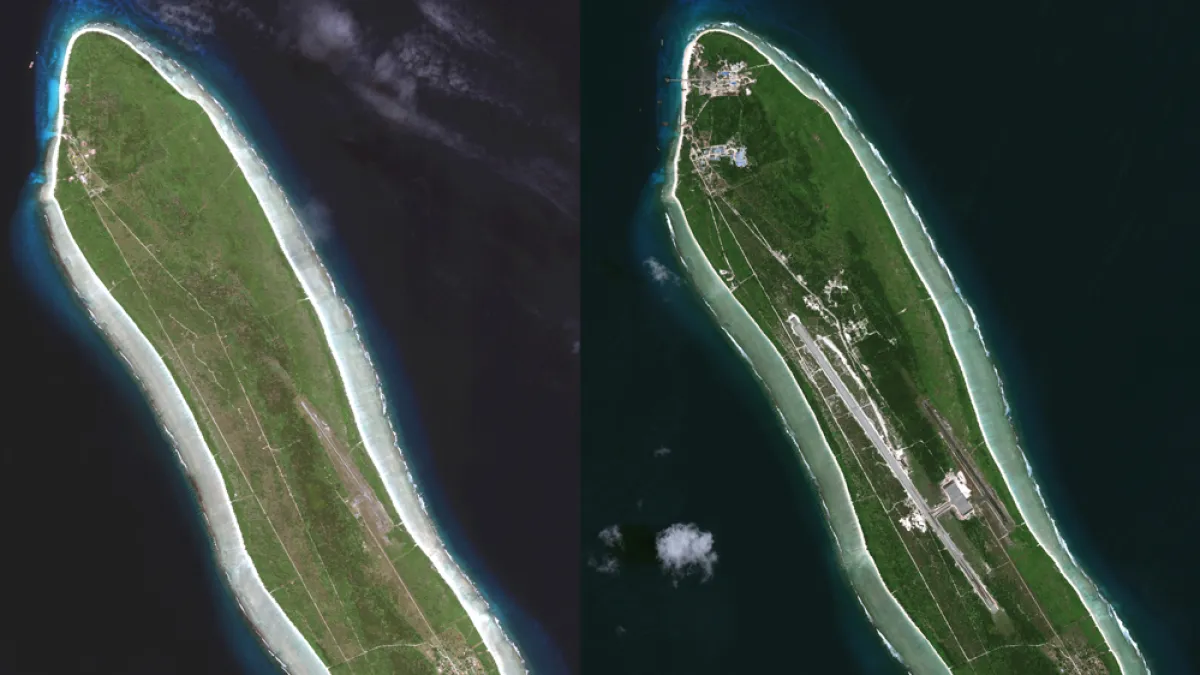
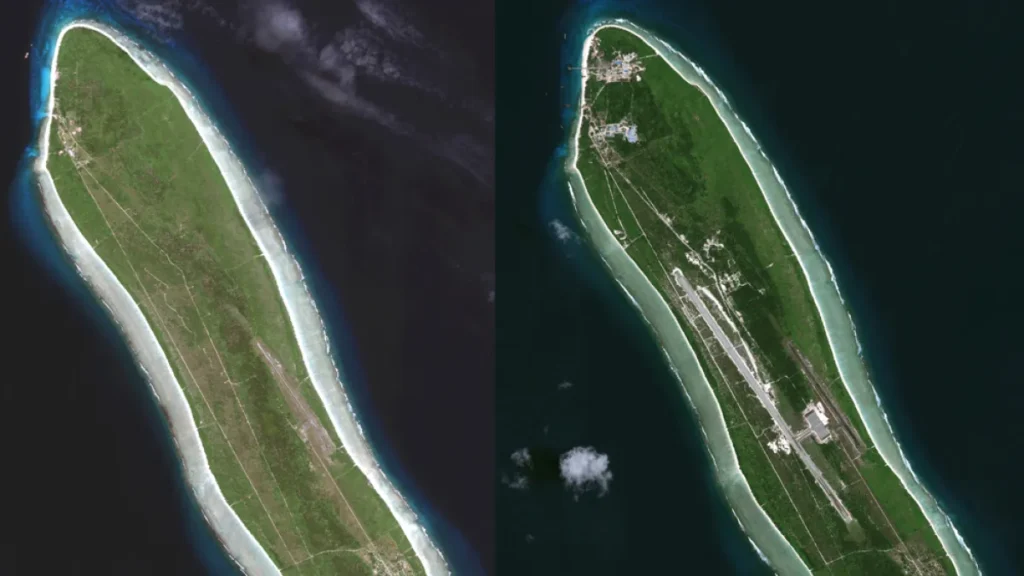
While official channels in Port Louis and New Delhi describe it merely as a development project for the local population, satellite imagery tells a starkly different story. A massive 3,000-meter runway, deep-water jetties, and reinforced hangars have appeared where there was once only thick vegetation.
This analysis cuts through the diplomatic noise to understand the hard military reality. It is not just an airstrip; it is India’s answer to China’s “String of Pearls.” It is the watchful eye that ensures the Indian Ocean remains truly Indian.
Strategic Data: The Facility at a Glance
Before we dive into the deep strategy, let’s look at the hard data regarding the Agalega Island India Base derived from open-source intelligence (OSINT).
| Feature | Specification | Military Utility |
| Runway Length | 3,000 meters (approx) | Can handle P-8I, C-130J, & Heavy Bombers |
| Location | 1,100 km North of Mauritius | Dominates the Mozambique Channel |
| Infrastructure | Deep Sea Jetty | Berthing for Frigates & Destroyers |
| Surveillance | Coastal Radar System | Tracks shipping movement 24/7 |
| Status | Operational | Forward Operating Base (FOB) |
1. Why the Agalega Island India Base Matters
To understand why India spent millions of dollars on this remote island, you have to look at the shipping lanes. The Mozambique Channel—the stretch of water between the African coast and Madagascar—is a global choke point. A significant portion of the world’s energy supply passes through here on its way to Asia.
Until now, the Indian Navy’s reach in this specific region was limited. Our primary bases are on the Indian mainland or the Andaman and Nicobar Islands in the East. The Western Indian Ocean was a gap in our armor. We relied on French facilities in Reunion island or goodwill visits.
The Agalega Island India Base plugs this gap permanently. It sits perfectly in the path of any Chinese warship entering the Indian Ocean from the Cape of Good Hope. From here, an Indian P-8I Poseidon aircraft can monitor the entire ocean. In military terms, this facility provides “Maritime Domain Awareness.” In simple terms, it means: We see you before you see us.
2. The Satellite Truth: A Runway Built for War
Diplomats can mince words, but high-resolution satellite images do not lie.
The most striking feature of the Agalega Island India Base is the runway. A 3,000-meter strip of tarmac is not built for small island-hopper planes carrying tourists or supplies. It is built for heavy lifters.
The P-8I Factor-
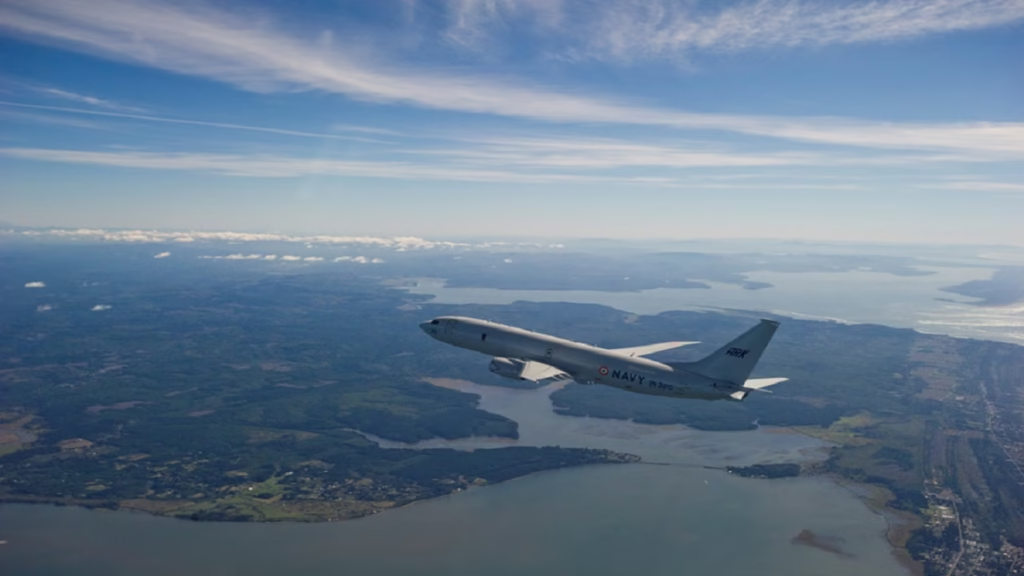
This length specifically accommodates the Boeing P-8I Poseidon, India’s premier maritime patrol aircraft. The P-8I is the hunter of the ocean packed with Harpoon missiles, torpedoes, and sensors that can sniff out a submarine hiding deep underwater.
By operating P-8Is from the Agalega Island India Base, the Indian Navy increases its “Time on Station.” Instead of flying 3,000 km from Goa to patrol the African coast and then flying back (burning fuel and time), the aircraft can now take off from Agalega, patrol for 10 hours, refuel, and go back up. This persistent surveillance makes it nearly impossible for China’s PLAN (People’s Liberation Army Navy) to move undetected.
Furthermore, the newly constructed deep-water jetties suggest that Indian warships frigates and destroyers can dock here for refueling and crew rest. This links directly to our recent analysis of the [RELOS Agreement India], where we discussed logistics as the key to global power.
3. The Origin Story: Modi’s 2015 Vision
The Agalega Island India Base did not appear overnight. Its roots trace back to Prime Minister Narendra Modi’s visit to Mauritius in 2015. It was during this tour that the MoU (Memorandum of Understanding) was signed for the “improvement of sea and air transportation facilities” on Agalega.
At the time, the project was sold as a civilian upgrade. The local inhabitants (numbering around 300) needed better connectivity to the main island of Mauritius. However, strategic experts knew that a runway larger than the one at Mauritius’ main international airport was overkill for 300 people.
Over the last decade, despite political opposition within Mauritius and an “India Out” campaign funded by rival powers, New Delhi stayed the course. The completion of the Agalega Island India Base in 2025 is a testament to India’s diplomatic persistence and the successful execution of the SAGAR (Security and Growth for All in the Region) doctrine.
4. The ‘Necklace of Diamonds’ Strategy
You have heard of China’s “String of Pearls” a network of military and commercial bases encircling India (Gwadar in Pakistan, Hambantota in Sri Lanka, Djibouti in Africa).
The Agalega Island India Base is the shining jewel in India’s counter-strategy, often called the “Necklace of Diamonds.” This strategy aims to build a counter-encirclement of China.
East: We have the Andaman & Nicobar Command (watching Malacca).
North: We have the RELOS agreement (watching the Arctic).
Central: We have the Chabahar Port in Iran.
South-West: Now, we have Agalega.
This creates a triangular net. Any hostile force entering this zone enters a “Kill Box” where Indian assets have the advantage of geography. It denies China the ability to use the Indian Ocean as a safe transit zone during a conflict.
5. Is it a Base or a ‘Facility’? The Diego Garcia Comparison
Official statements from both Port Louis and New Delhi emphasize that this is not a military base. They call it a facility for “capacity building” and “anti-piracy operations.”
Why the secrecy around the Agalega Island India Base?
Mauritius has a complex history with military bases. The Chagos Archipelago (Diego Garcia) was leased to the US by the UK, leading to the displacement of locals and a decades-long legal battle. Calling Agalega a military base would cause a political storm in Mauritius. Hence, the term “Dual-Use Facility” is used.
Diego Garcia vs. Agalega:
While Diego Garcia is a massive US bomber base capable of launching nuclear strikes, Agalega is currently a surveillance and logistics hub. It is not designed to launch offensive wars but to monitor and control the seas. However, in a wartime scenario, a “logistics hub” can easily turn into a launchpad for missiles. A facility that hosts military aircraft, military radars, and military personnel is a base in everything but name.
6. The China Reaction: Unease in Beijing
China has been closely monitoring the construction at Agalega. Their state media and defense experts often criticize India’s “hegemonic” ambitions in the Indian Ocean.
Why are they worried about the Agalega Island India Base?
Because it threatens their energy lifeline. China imports 80% of its oil from the Middle East and Africa through the Indian Ocean. If a conflict breaks out in the Himalayas, the Indian Navy doesn’t need to fight in the mountains. It can simply choke the energy supply lines in the Indian Ocean.
China has tried to counter this by sending its “Spy Ships” (Yuan Wang class) to the region. But with Agalega operational, these spy ships can no longer hide. Every move they make is tracked by Indian radars. Agalega acts as the unsinkable aircraft carrier that makes a naval blockade possible.

Conclusion: The Sentinel of the South
The transformation of Agalega from a sleepy coconut island to a strategic fortress is a testament to the new Indian strategic thinking. We are no longer just reacting to China; we are pre-empting them.
With the Agalega Island India Base operational, the Indian Ocean is finally living up to its name. The message to the world is simple: The waters may be international, but the security architecture is decidedly Indian. This facility ensures that while Beijing may have the larger fleet, New Delhi has the superior ground.
What do you think?
Is the Agalega Island India Base the ultimate answer to China’s String of Pearls?
Tell us in the comments.
Read Next: [How India’s Nuclear Triad ensures 360-degree protection against China.]