Strategic Intelligence Report | By Wish, Geopolitical Analyst
Global Energy War 2026
The Intelligence Brief: January’s Triple Shockwave
As of January 8, 2026, the world has officially moved past the era of diplomatic maneuvering and entered a period of Direct Resource Intervention. In the last five days, the global geopolitical map has been shaken by three events that have fundamentally altered the world order. The first was Operation Absolute Resolve on January 3, where US forces captured Venezuelan leader Nicolas Maduro in a daring strike.
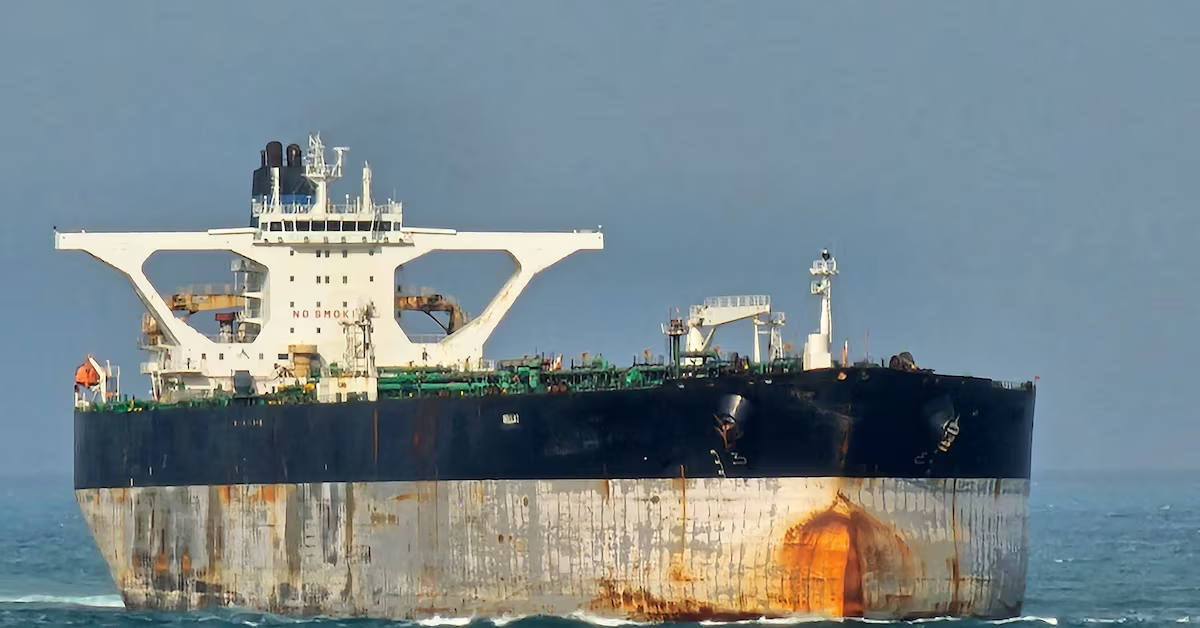
The second was the dramatic January 7 seizure of the Russian-flagged tanker Marinera in the North Atlantic. And the third, the most critical for New Delhi, is the greenlighting of a US bill that could impose a 500% tariff on nations like India that continue to buy Russian crude.
This is the Global Energy War 2026. It is no longer about ideology, it is a brutal, transactional struggle for energy sovereignty and resource control. For Washington, the capture of Venezuela is a Reassertion of American Power over the world’s largest oil reserves. For Moscow, the seizure of its shadow fleet is a declaration of maritime war.
For India, the first week of January has brought a strategic dilemma that threatens its very economic foundation. This report decodes the Triple Shockwave and what it means for the future of the Indo-Pacific.
1. Operation Absolute Resolve: The Fall of Caracas
The most dramatic event of the year occurred on January 3, 2026. In a lightning strike that surprised global intelligence agencies, US Special Operations forces executed Operation Absolute Resolve. The objective was Nicolas Maduro, the long-standing leader of Venezuela. By January 5, the world watched as Maduro was brought before a federal court in New York, charged with narcoterrorism and resource theft.
The Strategic Calculation
The capture of Maduro is not about regime change in the traditional sense; it is about Energy Leverage.
The Oil Vault: Venezuela holds approximately 300 billion barrels of proven oil reserves, the largest in the world. By removing Maduro, the US has effectively established a temporary administrative oversight over this vault.
Crashing the Russian Economy: The intent is to flood the global market with cheap Venezuelan heavy crude. This would drive oil prices down to a level where Russia can no longer afford to sustain its military operations or its domestic economy.
China’s Loss: Beijing has invested over $60 billion in Venezuela over two decades. With the US now running the oil fields, China’s primary energy anchor in the Western Hemisphere has been severed.
2. The Shadow Fleet War: The Seizure of the Marinera
While Caracas was falling, a different kind of war was unfolding in the North Atlantic. On January 7, 2026, the US Navy and Coast Guard conducted a forced boarding of the Russian-flagged tanker Marinera. This vessel was identified as a key asset in Russia’s Shadow Fleet, a network of aging tankers used to bypass Western price caps and sanctions.
Naval Confrontation in the Atlantic
The seizure was nearly the spark for a direct US-Russia naval conflict.
The Submarine Escort: Reports indicate that a Russian Yasen-class submarine was shadowing the Marinera and attempted to interfere with the US boarding party.
The Legal Shift: The US Department of Justice has reclassified shadow-fleet vessels as unregulated maritime threats, allowing for their seizure in international waters under environmental and safety pretexts.
Dismantling the Network: Washington is no longer just sanctioning companies, it is physically removing the ships from the ocean. This Kinetic Sanctions approach has sent shockwaves through the global shipping insurance market, making the cost of transporting Russian oil almost prohibitive.
3. The 500% Tariff: Trump’s Energy Ultimatum to India
For New Delhi, the most critical development of 2026 occurred on January 7, when the Trump administration greenlit a bill that authorizes a 500% tariff on any country purchasing Russian crude oil. This is not a subtle diplomatic nudge, it is an economic declaration of war on secondary buyers.
The Arrival of Sergio Gor
The timing is precise. India’s new US Ambassador-designate, Sergio Gor, is arriving in New Delhi on January 12. His portfolio is clear, deliver the final ultimatum on Russian oil.
Reliance Industry’s Response: India’s private refining giant, Reliance, has already signaled its compliance, announcing it will halt all Russian oil imports starting this month.
The Surplus at Risk: India currently enjoys a significant trade surplus with the US. A 500% tariff on Indian textiles, IT services, or generic drugs would devastate the Indian economy, forcing a sudden and painful decoupling from Moscow.
ISA Withdrawal: The US withdrawal from the International Solar Alliance (ISA) on the same day further emphasizes that Washington is prioritizing fossil fuel and nuclear hegemony over collaborative green diplomacy.

4. Greenland: The White Gold High Ground
Beyond oil, the Global Energy War 2026 has extended into the Arctic. Greenland has become the ultimate strategic prize for Rare Earth Elements (REEs).
As of January 8, 2026, Greenland’s government has officially prioritized Western alliances over Chinese mining interests, aligning itself with the US and Denmark to secure the White Gold of the North.
The Resource Fortress: Greenland possesses 39 of the 50 minerals the US classifies as critical. By securing Greenland’s Neodymium and Dysprosium, the US aims to permanently break China’s 80% monopoly.
This is no longer just about mining, it is about building a stationary aircraft carrier for Arctic resource dominance.
Watch: The high-stakes strategic battle between the US and China over Greenland’s rare earth minerals.
5. The Futuristic Forecast: Privateers and Energy Blocks
Looking deeper into the trends of 2026, we are witnessing the birth of Energy Blocs.
- The US-Led Bloc: Controlled by American shale, Venezuelan heavy crude, and Greenland’s minerals.
- The Eurasian Bloc: Led by Russia and Iran, struggling to bypass US maritime blockades through Shadow Fleets and land-based pipelines.
- The Dilemma of the Neutrals: Nations like India, Brazil, and China are being forced to choose sides. My prediction is that 2026 will see the rise of Maritime Privateers, private security companies hired to protect non-aligned oil tankers from being seized by US or Russian naval assets.
6. Strategic Integration: The 2026 India Roadmap
India must now navigate the most complex diplomatic storm of the decade.
Silicon Dependence: India’s Semiconductor Mission 2026 relies on US technology, making it impossible to ignore Washington’s oil ultimatum.
The Energy Pivot: The threat to oil imports will force India to accelerate its Nuclear and Thorium Roadmap. The lesson of January 2026 is that energy dependency is the single greatest vulnerability to India’s rise as a superpower.
7. Strategic Vulnerability Matrix 2026: India’s Energy Profile
Instead of a simple formula, we must look at the Multi-Factor Risk Assessment for the first quarter of 2026. This matrix evaluates India’s current exposure to the global energy war.
| Risk Factor | Exposure Level | Strategic Impact |
| Import Dependency | CRITICAL (85%) | High vulnerability to global price shocks and maritime blockades. |
| Tariff Pressure | SEVERE (500%) | Threat to the trade surplus; could lead to a localized industrial recession. |
| Geopolitical Friction | HIGH (US-Russia) | India is caught in the crossfire of “Secondary Sanctions” and the Shadow Fleet war. |
| Mitigation Speed | MODERATE | While SMR and Solar plans are fast, they cannot replace oil in the next 12 months. |
Conclusion of Assessment: India’s current energy security is at its most fragile state since the 1973 oil crisis. The Dual-Source strategy (buying from both West and East) is no longer viable in a world where the West is enforcing Absolute Resolve.
8. The 2026 Strategic Roadmap: Milestones
January 12, 2026: Arrival of Sergio Gor in New Delhi, final decision on Russian crude.
Q1 2026: Potential US-India deal on Strategic Petroleum Reserves to offset Russian losses.
Q2 2026: First commercial mining operations begin in Greenland under US-Danish-Greenlandic pact.
December 2026: Full integration of the Energy Sovereignty protocols into India’s National Security Strategy.
Conclusion: The End of Hesitation
The events of the first week of January 2026 have proven that the global energy market is no longer a marketplace, it is a battlefield. The capture of Venezuela, the seizure of the Marinera, and the threat of the 500% tariff show that the Rule-Based Order has been replaced by Interest-Based Enforcement.
For India, the era of playing both sides has come to an abrupt end. As the new US Ambassador arrives in New Delhi next week, India must decide whether its long-term future lies with the volatile Shadow Fleet of the past or the high-tech, transactional energy alliances of the future.
In 2026, energy is no longer a commodity, it is the ultimate weapon of sovereignty.
Recommended Reading: The Strategic Pillars
Nuclear Shield: India’s Nuclear Renaissance 2026: The Thorium & SMR Roadmap
Southern Anchor: The Great Nicobar Gamble 2026: Amit Shah’s $11 Billion Vision
Silicon Core: India Semiconductor Sovereignty 2026: The Micron & Tata Reality
The Ghost Fleet: Indo-Pacific Ghost Fleet 2026: The Autonomous Naval Doctrine