By Wish | Defense Intelligence
The Silent Guardian Rises
While the world discusses aircraft carriers like INS Vikrant, the real game-changing weapon of the Indian Navy operates in total silence, hundreds of meters underwater.
Reports indicate that India is on the verge of commissioning its second (and much larger) nuclear-powered ballistic missile submarine (SSBN), codenamed S-4 and likely to be christened INS Aridaman.
Unlike its predecessor INS Arihant, which was largely a “Technology Demonstrator” with limited range, INS Aridaman is a fully combat-ready “Monster of the Deep.” It is bigger, faster, and carries a punch that can reach Beijing from the safety of the Bay of Bengal.
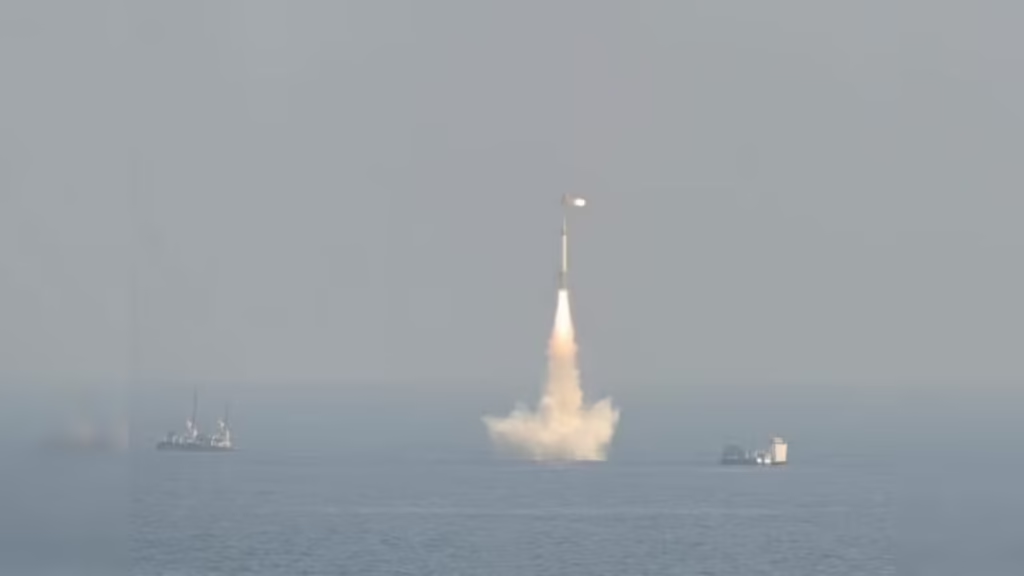
December 2025 Intelligence Update: As of late December 2025, a high-priority Long-Range NOTAM has been issued for the Bay of Bengal, covering a vast maritime corridor. Defense analysts, including the team at India Pacific Post, suggest this is the final ‘Validation Launch’ of the K-4 SLBM from the submerged tubes of the INS Aridaman (S-4).
This move marks the completion of the S-4’s ‘User Trials’ phase, signaling that the vessel is now moving toward formal commissioning by early 2026. This launch is a direct response to the persistent presence of Chinese ‘Yuan Wang’ class tracking ships in the region, asserting India’s subsurface dominance.
This analysis decodes the technology, the firepower, and the strategic doctrine behind India’s most expensive military asset.
Strategic Comparison: Arihant (S-2) vs. Aridaman (S-4)
| Feature | INS Arihant (S-2) | INS Aridaman (S-4) |
| Displacement | 6,000 Tonnes | 7,000+ Tonnes |
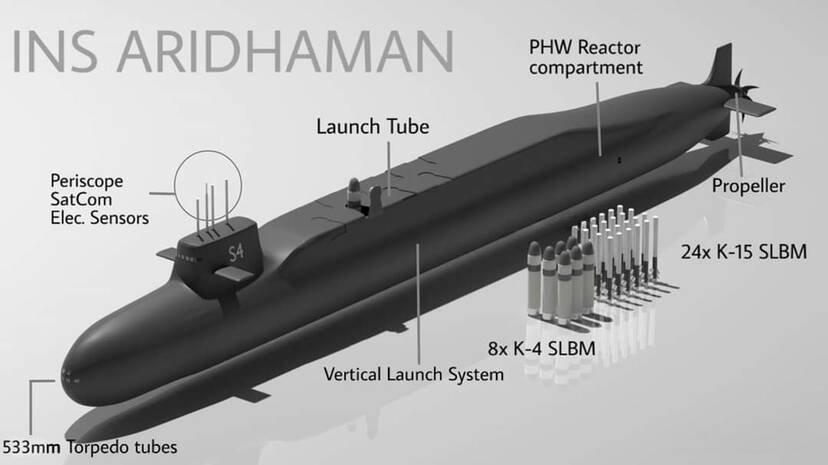
| Missile Tubes | 4 | 8 (Double Capacity) |
| Primary Weapon | K-15 (750 km range) | K-4 (3,500 km range) |
| Role | Training/Deterrence | Full Strategic Strike |
1. Why S-4 is a “Monster”? The K-4 Factor
The biggest limitation of the first submarine, INS Arihant, was its reach. It carried K-15 missiles with a range of only 750 km. To hit strategic targets in China, Arihant would have to sail dangerously close to Chinese waters, risking detection.
INS Aridaman solves this geography problem.
The Weapon: It is armed with the K-4 Submarine Launched Ballistic Missile (External Link).
The Range: With a range of 3,500 km, the K-4 allows INS Aridaman to sit safely in the “Bastion” of the Bay of Bengal and still target Beijing, Shanghai, and Islamabad. This is true “Second Strike Capability.“
The Payload: It can carry up to 8 of these massive missiles (compared to Arihant’s capacity for K-15s). This means a single submarine can devastate multiple cities in a retaliatory strike.
2. Stealth Technology: The “Double Hull” Advantage
Naval experts suggest that INS Aridaman features a significantly improved design over the Arihant class. In submarine warfare, “Silence is Survival.” If you are quieter than the ocean background noise, you are invisible.
The recent December 2025 NOTAM activity highlights the precision of India’s 3,500 km range K-4 SLBM. Unlike previous tests, the 2025 trials from the S-4 platform focus on ‘Rapid Salvo Launch’ capabilities—the ability to fire multiple nuclear-tipped missiles in quick succession from a submerged position. With its 8 vertical launch tubes (double the capacity of the INS Arihant), the INS Aridaman now provides a credible ‘Second Strike’ option that can target major strategic hubs deep within mainland China while remaining hidden in the deep-water bastions of the Bay of Bengal.
Double Hull Construction: Unlike Western submarines which often use a single hull, the S-4 reportedly uses a Russian-inspired Double Hull design. The outer hull absorbs sonar waves, making it harder for enemy destroyers to “ping” its location.
Reactor Power: It is powered by a more efficient 83 MW pressurized light-water reactor (PWR) using highly enriched uranium. This allows the submarine to stay submerged for months, limited only by the food supply for the crew.
3. China’s Type 094 vs. India’s S-4
How does it stack up against the enemy?
China’s Jin-class (Type 094) submarines are bigger (11,000 tonnes), but they have a fatal flaw: Noise. US Navy reports often call them “noisy trucks” that are easy to track by SOSUS sensors.
The Indian Edge: India’s S-4 focuses on Stealth over Size. By keeping the submarine smaller but quieter, India aims to win the game of “Hide and Seek” in the Indian Ocean.
The Patrol Game: While China struggles to keep a continuous SSBN patrol in the Indian Ocean due to logistics, INS Aridaman operating from the new base at Rambilli (Project Varsha) has direct access to deep waters.
4. The “Bastion” Strategy: A New Doctrine
With the induction of INS Aridaman, India can now fully implement the “Bastion Strategy.”
Instead of sending submarines far away to hunt enemy ships, India will keep its SSBNs (Nuclear Subs) close to the Indian coast, protected by a ring of surface ships and aircraft like the P-8I Poseidon.
The Logic: Why go to the enemy when you can hit them from home? This makes the S-4 virtually invulnerable to Chinese “Hunter-Killer” submarines.
Project Varsha: This strategy is supported by the secret submarine base being built at Rambilli (near Visakhapatnam), which features underwater tunnels allowing submarines to enter and exit without being seen by satellites.
5. The Crew: Life Inside the Iron Coffin
Operating INS Aridaman is not just about machines; it is about men. The crew of nearly 100 sailors lives in a steel tube for 60 to 90 days at a stretch.
Isolation: They have no internet, no phone calls, and no sunlight.
The “Red Button” Responsibility: The captain and executive officers are trained to execute the launch order within minutes of receiving the coded signal from the Strategic Forces Command (SFC). The psychological resilience required to operate the S-4 is higher than any other branch of the military.
-The timing of this final trial in late 2025 is a calculated geopolitical signal. By issuing a NOTAM that overlaps with major global trade routes, New Delhi is showcasing its ‘Blue Water’ confidence. The successful validation of the S-4’s strike capability effectively closes the ‘deterrence gap’ in the Indo-Pacific. As the S-4 prepares to join the fleet, India moves from a single-vessel patrol to a Continuous At-Sea Deterrence (CASD) posture, ensuring that at least one nuclear-armed hunter is always silently lurking in the depths, 24/7.”
Conclusion: Completing the Nuclear Shield
The commissioning of INS Aridaman is not just about adding a ship; it is about completing India’s nuclear shield. It guarantees that no matter how powerful a first strike the enemy launches, there will always be a survivor in the deep—ready to deliver a catastrophic response.
As the S-4 slips silently into the dark waters, the balance of power in the Indo-Pacific shifts just a little bit more towards New Delhi. The “Monster of the Deep” is awake.
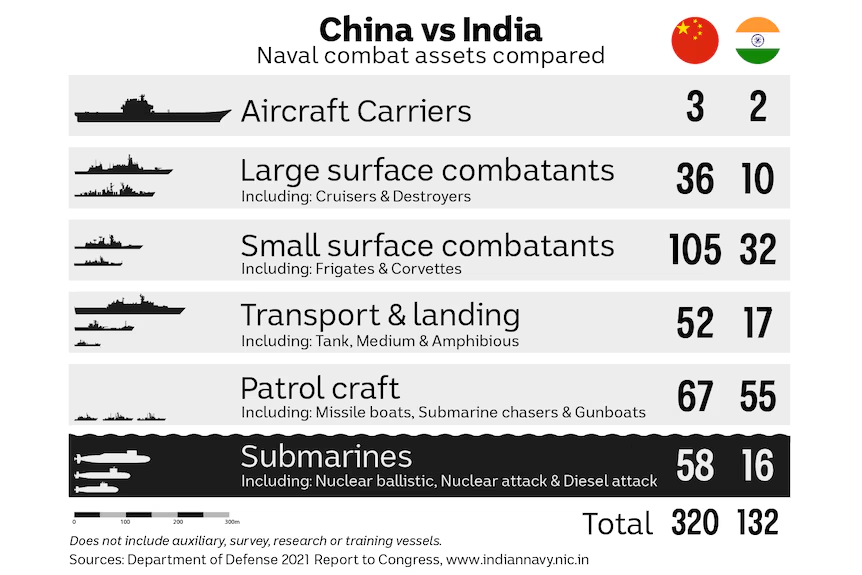
While INS Aridaman strengthens India’s underwater nuclear triad, the Indian Navy is also expanding its surface dominance. You can read our detailed comparison of India vs China Aircraft Carrier: INS Vikrant vs Fujian to understand the battle for the Indian Ocean.
What do you think? – Should India focus more on Nuclear Submarines (SSBNs) or Aircraft Carriers?
Let us know in the comments.
Read Next: [How the K-4 Missile technology connects to the Agni-5 MIRV program.]
The commissioning of the INS Aridaman (S-4) is only one piece of India’s massive naval puzzle. To understand how this ‘Monster of the Deep’ will be protected and maintained, you must explore our deep-dives into India’s other strategic naval pillars:
The Escort Force: While the S-4 provides the nuclear sting, it requires a fleet of hunter-killer submarines for protection. Read our full intelligence report on India’s Project 77 Nuclear Submarine: The $14 Billion Hegemony to see how India’s SSNs will secure the Indo-Pacific.
The Western Fortress: While the S-4’s primary home is the secretive INS Varsha, its maintenance and logistics will be supported by Asia’s largest naval base. Explore our analysis of Project Seabird Phase IIA 2026: Establishing Asia’s Largest Naval Fortress in Karwar.
The Strategic Encirclement: See how these subsurface assets fit into New Delhi’s broader maritime move against China: The Necklace of Diamonds Strategy: India’s Silent Counter to the String of Pearls.